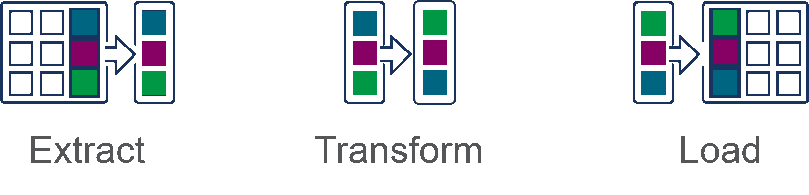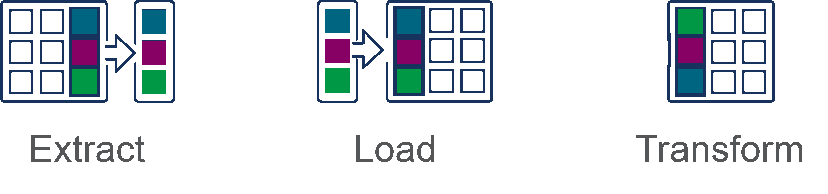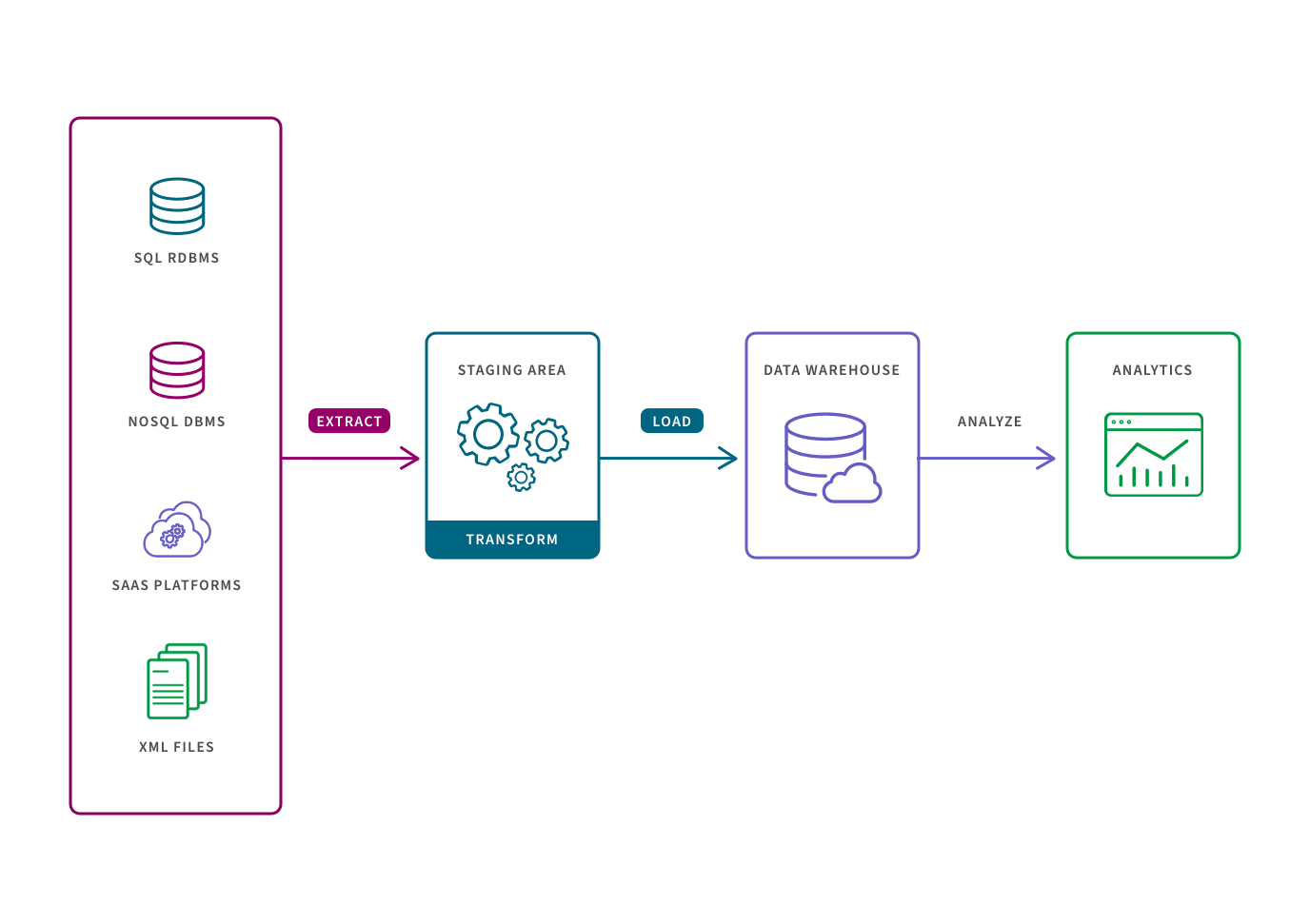

Extraction, Transformation and Loading (ETL) processes are critical components for feeding a data warehouse or business intelligence system. While mostly invisible to users of a business intelligence platform, ETL processes retrieve data from all operational systems and pre-process it for further analysis by reporting and analytics tools. The accuracy and timeliness of the entire business intelligence platform rely on ETL processes, specifically:
- Extraction of the data from production applications and databases (ERP, CRM, RDBMS, files, etc.)
- Transformation of this data to reconcile it across source systems, perform calculations or string parsing, enrich it with external lookup information, and also match the format required by the target system (Third Normal Form, Star Schema, Slowly Changing Dimensions, etc.)
- Loading of the resulting data into various business intelligence (BI) applications: Data Warehouse or Enterprise Data Warehouse, Data Marts, Online Analytical Processing (OLAP) applications or “cubes”, etc.
Obstacles: Managing Diverse Data
There are numerous challenges to implementing efficient and reliable ETL processes.
- Data volumes are growing exponentially and ETL processes have to process large amounts of granular data (products sold, phone calls, banking transactions, weblog files). Some Business Intelligence (BI) systems merely get incrementally updated, whereas others require a complete reload at each iteration.
- As information systems grow in complexity, the disparity of sources is growing as well. ETL processes need comprehensive connectivity for a wide range system, including packaged applications (ERP, CRM, etc.), databases, mainframes, files, Web Services and SAAS applications.
- Business intelligence structures and applications include data warehouses, data marts, and OLAP applications for analysis, reporting, dashboarding, scorecarding, etc. All these target structures have different data transformation requirements and different tolerances in terms of latency.
- Transformations involved in ETL processes can be highly complex. Data needs to be aggregated, parsed, computed, statistically processed, etc. BI-specific transformations are also required, such as Slowly Changing Dimensions.
- As business intelligence analysis tends toward real-time, data warehouses and data marts need to be refreshed more often and the load time windows have shrunk.
- Primary keys are some of the most important attributes in relational databases as they tie everything together. Quite often data integration projects deal with multiple data sources and therefore need to address the issue of having multiple keys in order to make any meaningful sense of the combined data.
Solution: Talend ETL for Analytics
Talend's open source data management solutions are optimized for enterprise-grade ETL. The following features are especially critical to the design, development, execution and maintenance of open source data integration and ETL processes:
- A highly scalable and fast execution open source platform that leverages a grid of commodity hardware, and the only solution to support the dual ETL and ELT architecture.
- Broadest data integration connectivity to support all systems and get access to all the production data and easily add new source systems.
- Built-in advanced components for ETL, including string manipulations, Slowly Changing Dimensions, automatic lookup handling, bulk load support and data mapping tools that can handle complex data mappings.
- Business-oriented process modeling that involves business stakeholders and ensures proper communication between IT and lines of business.
- Fully graphical development environment that greatly improves productivity and facilitates maintenance.
Talend Products
Talend Data Integration
Talend provides an extensible and highly-scalable set of data integration tools to access, transform and migrate data from any business system. With support for over 450 types of data sources, Talend simplifies your data ETL needs.
Talend Data Quality
Talend provides a powerful open source-based data quality solution that delivers end-to-end profiling, cleansing, matching and monitoring capabilities with the ability to identify anomalies, standardize data, resolve duplicates and monitor data quality over time. Data consistency is improved as integrate systems.
Unlike other solutions where you need to integrate products to make a solution, Talend’s products improve your productivity through a unified platform - a common code repository and tooling for scheduling, metadata management, data processing and service enablement.
Talend Data Management
Talend Data Management turns disparate, duplicate sources of data into trusted stores of consolidated information, so your business can be more responsive and confident in daily decisions.